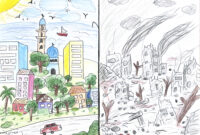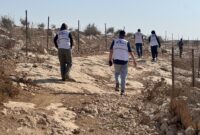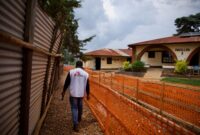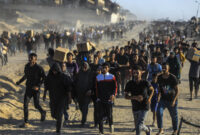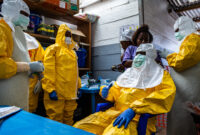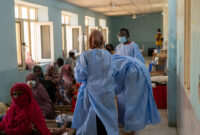
Illustration of a street in Cité Soleil, a neighbourhood controlled by armed groups. Haiti, 2026. © Vicky Onélien
SHARE THIS:

Haiti: People risk their lives to seek medical care

The Cité Soleil neighbourhood is a prime example of the barriers to accessing healthcare in Port-au-Prince

In Port-au-Prince, Haiti, armed groups continually battle the government and its supporters for territorial control. This violence prevents residents from freely moving around in the city and the few hospitals still operating are sometimes forced to suspend activities for security reasons.

The situation is particularly critical in the commune of Cité Soleil, which is controlled by armed groups. Within the commune, roads are regularly blocked by barricades or checkpoints, where the risk of being stopped, arrested, assaulted or even killed is constant. When residents of these neighbourhoods need medical care, they face an impossible dilemma: risk seeking treatment or letting their condition worsen.

“In less than 12 hours, the teams treated more than 40 patients with gunshot wounds. A guard was hit by a stray bullet inside the hospital compound.”

Thomas Curbillon, MSF country director

Ronaldo* has had asthma for two years. He was first prescribed medication, then an inhaler. Yet the 19-year-old suffers greatly from the illness, both because of the cost of treatment and because of the grip armed groups hold over many neighbourhoods of Port-au-Prince.

A fictional portrait of Ronaldo, a young man suffering from asthma in Port-au-Prince. Haiti, 2026. © Vicky Onélien

“When the security situation gets worse and there’s gunfire, I can’t go out, especially when asthma attacks hit,” Ronaldo says about trying to reach the Doctors Without Borders/Médecins Sans Frontières (MSF) hospital in Cité Soleil. “In those moments, my family pours cold water over my body to try to relieve me.”

Illustration of an intersection in Port-au-Prince following clashes between armed groups. Haiti, 2026. © Vicky Onélien

The impossibility of providing care amid gunfire

In early May 2026, intense fighting broke out between several rival armed groups in the communes of Cité Soleil and Croix-des-Bouquets. “The clashes came within less than 200 metres of the medical facility’s perimeter,” says Thomas Curbillon, MSF country director. “In less than 12 hours, the teams treated more than 40 patients with gunshot wounds. A guard was hit by a stray bullet inside the hospital compound.” Several hundred people — staff, their families, civilians from the neighbourhood — took refuge there. Faced with this extreme spike in violence, MSF was forced to evacuate patients and staff on May 11, 2026, and temporarily suspend activities.

Illustration of the entrance to the MSF hospital in Cité Soleil, Port-au-Prince. Haiti, 2026. © Vicky Onélien

The hospital remained closed for three weeks, until June 1. This was the third time in three years that MSF made the difficult decision to suspend medical activities in Cité Soleil. “Under normal circumstances, the outpatient department sees around 150 patients a day and bed occupancy often exceeds 80 per cent,” says Curbillon. “That gives an idea of the consequences for the communities when our activities are interrupted for several weeks.”

Even when the hospital is open, violent clashes still prevent people from reaching it. “The fighting can trigger heavy automatic weapon fire across entire streets or neighbourhoods around our hospital,” says Sarah Chateau, MSF’s head of operations for Haiti. “When that happens, patients don’t come — they try as hard as they can to avoid getting caught in crossfire. The hospital is then almost deserted, and our patients with chronic illnesses — except those already admitted — lose access to care.”

Illustration of a medical transfer to the MSF-supported Tabarre hospital. Haiti, 2026. © Vicky Onélien
Illustration of a surgical procedure at a medical facility in Port-au-Prince. Haiti, 2026. © Vicky Onélien

Armed clashes also deprive women of maternal and newborn healthcare. In June 2026, violence in Cité Soleil and around the MSF-supported Isaïe Jeanty maternity hospital forced MSF teams to suspend their medical activities for several weeks.

A healthcare system pushed to breaking point 

When a patient chooses to risk seeking care, there is no guarantee that they will find a facility able to treat them. The capacity of care has collapsed. According to the World Health Organization (WHO), only 26 per cent of medical facilities are still fully functional. The rest have closed, been looted or are operating at reduced capacity for lack of staff, equipment or safe conditions.

“The small hospitals in my neighbourhood were destroyed and everything in them was looted,” says Rosemie*, who lives in Cité Soleil and has diabetes. At 76, she was hospitalized for several days at the MSF hospital in Cité Soleil. She had recently discovered she was diabetic and her condition had deteriorated. Before this episode, she knew nothing of the disease and had only heard it “kills people, gives them wounds and can even lead to amputation.” When she came in for a consultation at MSF, she could no longer walk. The illness had weakened her and she had lost weight.

Illustration of a consultation at an MSF facility in Port-au-Prince. Haiti, 2026. © Vicky Onélien

“The Ministry of Health’s budget is very limited. Haiti’s humanitarian crisis has been underfunded internationally for years,” says Chateau. This leaves few options for transferring serious cases to the MSF hospital in Cité Soleil and increases risk to those needing specialized care. “In this context, someone with a chronic illness has little chance of being able to continue their treatment and in the event of a severe episode, their life can be at risk,” Chateau says.

Chronic diseases: The leading cause of death in Haiti

“While the MSF hospital was closed, I had nowhere to go,” says Maryse*, a woman living with diabetes and hypertension. “I can’t afford to go to a private hospital or even buy my medication.”

A fictional portrait of Maryse, an older woman with diabetes in Port-au-Prince. Haiti, 2026. © Vicky Onélien

Chronic diseases have several distinctive features, including accompanying people throughout their lives and requiring regular monitoring and medication. “Accessing care can prove very difficult in the Haitian context,” says Dr Jérôme Fritsch, medical referent at the MSF hospital in Cité Soleil. “Conditions like diabetes, hypertension, asthma or epilepsy require medication that is often expensive and sometimes unavailable at pharmacies because of supply problems.”

In the emergency department of the MSF hospital, medical teams see around 30 patients each day. Around 10 per cent are in acute crisis linked to a chronic illness. The clinical picture varies depending on each person’s illness. “In the case of hypertension, these are patients who can no longer breathe properly, whom we may need to put on oxygen and treat for edema,” says Fritsch. “Diabetic patients, whose blood sugar is too high, can fall into diabetic ketoacidosis, which is the leading cause of death from diabetes.”

Illustration of the waiting room at the MSF hospital in Cité Soleil, Port-au-Prince. Haiti, 2026. © Vicky Onélien

Patients are given medication before returning home. “When a diabetic patient is discharged, they have to keep taking their insulin at home, monitor their blood sugar and diabetes-related complications and make sure they eat a balanced diet,” says Fritsch. “That’s extremely difficult for this type of patient.”

Although it is the leading cause of death in Haiti according to the WHO, MSF teams see relatively few deaths linked to chronic diseases at the Cité Soleil hospital. “Most deaths happen outside of health facilities, because people are unable to travel due to violence or the cost of transport, or because they are too frail and facing an acute crisis,” says Fritsch.

Since March 2026, a partnership with the Haitian Foundation for Diabetes and Cardiovascular Diseases (FHADIMAC) has made possible a year of follow-up care to certain hypertensive or diabetic patients. “To benefit from this program, patients must first have been admitted to MSF’s emergency department for a crisis linked to one of these illnesses,” says Fritsch. “We hope this care can help break the vicious cycle these patients are trapped in, between emergency care, stabilization, hospitalization, returning home, difficulty accessing treatment and going back to the emergency room.”

Illustration of a woman purchasing medications in a pharmacy in Port-au-Prince. Some medicines are difficult to obtain due to shortages, high prices or looting. Haiti, 2026. © Vicky Onélien

However, complications linked to chronic diseases require specialized care that is sometimes unavailable in the Haitian capital. Without follow-up, a person with hypertension can suffer a stroke, “a situation for which there is almost no solution in Port-au-Prince,” says Fritsch.

Cost of living and stigma: Further obstacles to accessing care

The recent surge in fuel prices has driven up the cost of food and transport, further entrenching the cycle of poverty for people in the most vulnerable situations. “Our care is free, but there are people for whom simply having to take a mototaxi to get here — which costs around 100 gourdes, or about $1 Canadian— means they can’t afford the transport and so they can’t reach our hospital,” says François Batistin, MSF deputy project coordinator in Cité Soleil.

Illustration of a person on the back of a motorcycle taxi in the streets of Port-au-Prince. Haiti, 2026. © Vicky Onélien

Stigma faced by residents of Cité Soleil is also a problem. “People from Cité Soleil are afraid to go into other neighbourhoods, like Delmas or Pétion-Ville, for example,” Batistin says. “They could be mistaken for members of armed groups or suspected by the Haitian police of being linked to them. Cité Soleil is the most populous commune in the greater Port-au-Prince area, and yet it is a zone completely abandoned by the State, with a bad reputation because of the control exerted by armed groups.”

For several years, Haiti has faced a deep, multidimensional crisis. Cité Soleil is home to around 300,000 people and medical needs are immense. “People struggle to leave Cité Soleil to get treatment elsewhere, while people from outside take the risk of coming into Cité Soleil to see MSF because the medication is good quality and the care is free,” says Batistin.

For 15 years, MSF has continuously adapted its response to an ever-evolving crisis. But they cannot make up for the collapse of the health system alone. Whenever residents must risk their lives to seek healthcare, quality care will remain a major humanitarian emergency in Port-au-Prince.

*Names have been changed to protect identity