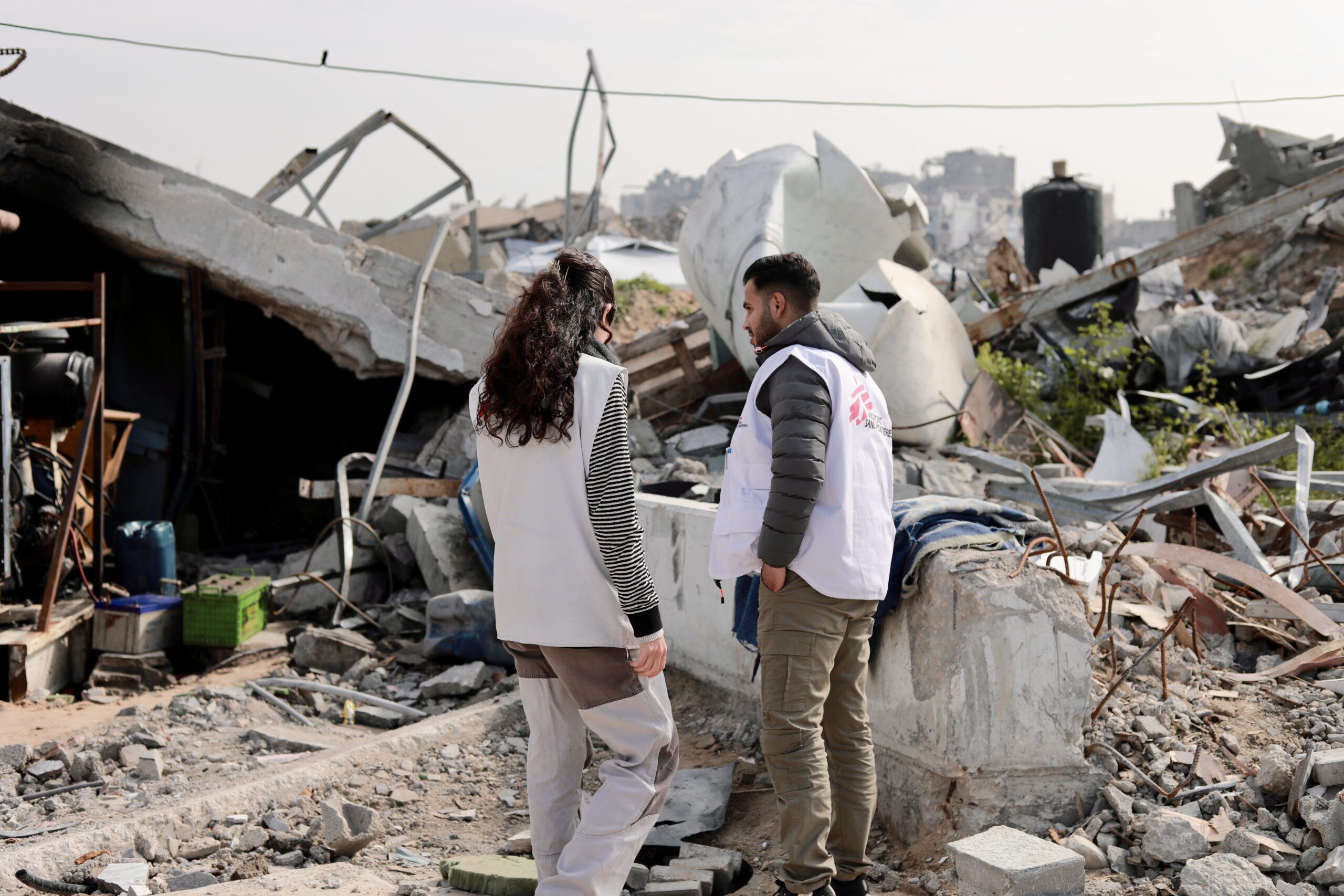
Addressing frequently asked questions and allegations about MSF’s work in Gaza
Doctors Without Borders/Médecins Sans Frontières (MSF) provides a vast amount of critical healthcare in Gaza, Palestine, yet even this is not enough to meet people’s overwhelming needs. Israel is now taking steps to stop the work of 37 NGOs, including MSF, in Gaza and the West Bank, by threatening to withhold registration. This comes on top of the intimidation, pressure, and smear campaigns that we and other aid organisations have faced from Israeli authorities while working in, and speaking out about, Gaza and the West Bank. Below, MSF responds to frequently asked questions about the reality of our work on the ground and our ongoing assessments about the registration process to continue working in Palestine.
What is MSF’s response to accusations by Israeli authorities that its medical work in Gaza is not significant or needed?
In 2025 alone, MSF teams:
- handled over 100,000 trauma cases;
- managed the care for over 400 hospital beds;
- performed 22,700 surgical operations on nearly 10,000 patients;
- carried out almost 800,000 outpatient consultations;
- administered 45,000 vaccinations;
- assisted in more than 10,000 births;
- provided more than 40,000 individual mental health sessions and group sessions for over 60,000 people;
- distributed more than 700 million litres of water
- produced nearly 100 million litres of clean water.
Many of the services provided by MSF are largely unavailable elsewhere in Gaza due to the destruction of the health system.
As of Jan. 1, 2026, MSF’s registration is no longer valid, and we will be required to cease operations by March 1, 2026. If MSF loses access to Gaza, hundreds of thousands of people will lose access to critical medical care and water. MSF’s vital work serves nearly half a million people in Gaza.
In Gaza, MSF is currently supporting six public hospitals and running two field hospitals. We also support seven general healthcare centres and run an inpatient feeding centre for people with malnutrition. MSF has recently opened six new medical points where we provide wound care and other general healthcare services. MSF has been working in Palestine since 1988.
Is it true that MSF has not cooperated with Israel?
For many months, MSF has unsuccessfully sought dialogue with the Israeli authorities on the renewal of our registration to work in Palestine. We remain open to dialogue with the Israeli authorities to maintain our critical medical operations in Gaza and the West Bank and to ensure that MSF can continue delivering essential, lifesaving medical care to people in desperate need, whilst safeguarding our teams. We would consult our Palestinian colleagues on any possible next step.
By accusing MSF, as well as other NGOs, of not cooperating and creating smear campaigns against aid organizations, Israel is using unfounded allegations to arbitrarily restrict access to critical care for Palestinians and limit witnessing from independent organizations. This type of accusation contributes to the delegitimization of humanitarian workers who are delivering vital care and services under extremely challenging conditions.
We observe that such accusations fit within a long-standing pattern used by Israeli authorities, alongside numerous physical and bureaucratic obstacles, to restrict the entry and delivery of aid into Gaza. Similar tactics were used in 2024 against UNRWA. Allegations are used to justify actions which stand in clear contradiction to the Israeli government’s claims that it is facilitating the provision of humanitarian assistance to the Gaza Strip.
What is the status of MSF’s registration to operate in Gaza and the West Bank?
As of Jan. 1, 2026, MSF’s registration to work in Gaza and the West Bank has expired and is therefore no longer valid. As such, we are required to cease operations by March 1, 2026.
We are seeking avenues to ensure that our humanitarian response continues in Gaza and the West Bank. We are also engaging with the Israeli authorities to ensure we can continue our activities, the prevention of which is a direct violation of UN Security Council Resolution 2720 – which calls for the unimpeded delivery of humanitarian aid to civilians.
For 2026, MSF has committed an estimated $160 to $190 million (100 to 120 million euros) for our humanitarian response in Gaza.
Is it true that MSF considered providing a defined staff list to Israel?
In an effort to explore every possible option – however limited – to continue providing critical medical care, MSF informed Israeli authorities on 23 January that, as an exceptional measure, MSF would be prepared to share a defined list of Palestinian and international staff names, subject to clear parameters, with our staff safety at its core. This position was defined following consultation with our Palestinian colleagues and with the clear
understanding no staff information would be shared without the express agreement of individuals concerned.
However, despite repeated efforts, it became evident that we were unable to build engagement with Israeli authorities on the concrete assurances required. These included that any staff information would be used only for its stated administrative purpose and would not put colleagues at risk; that MSF would retain full authority over all human resource matters and management of medical humanitarian supplies, and that all communications defaming MSF and undermining staff safety would cease.
As a result, and in the absence of these clear assurances, we have concluded that we will not share staff information in the current circumstances. MSF remains open to ongoing dialogue with the Israeli authorities to maintain our critical medical operations in Gaza and the West Bank and to ensure that MSF can continue delivering essential, lifesaving medical care to people in desperate need.
Did MSF provide Israel with a staff list at any time?
No, we have not at any moment handed over any list of our national or international staff to Israeli authorities as part of this registration process.
Why did MSF consider sharing a defined staff list with Israel?
Expelling MSF, alongside dozens of other humanitarian organizations, would deprive hundreds of thousands of people of essential medical care. MSF is one of the few international organizations able to witness and denounce the ongoing genocide and if we are forced to leave, we will lose this ability.
Israeli authorities have forced humanitarian organizations, including MSF, into an impossible choice – between sharing information about our staff or interrupting critical medical care in a context of staggering humanitarian needs and extreme violence against health workers. Facing the imminent threat of the closure of our projects, MSF wanted to explore all possible chances to continue providing medical care in Gaza and the West Bank. As such, we wrote to the Israeli authorities explaining that as an exceptional measure, under exceptional circumstances, we would be prepared to provide a defined staff list subject to clear parameters with staff safety at its core.
We did not share the personal details of any of our colleagues. Despite repeated efforts, it became evident that we were unable to build engagement with Israeli authorities on the concrete assurances required. As a result, and in the absence of these clear assurances, we have concluded that we will not share staff information in the current circumstances.
How did MSF consult with Palestinian staff on Israel’s request for a staff list?
This process included dialogue across teams and most critically with our Palestinian colleagues, taking into account their perspectives and concerns, including with respect to their personal safety and the consequences of MSF’s potential withdrawal.
Throughout, we stressed that no information would be shared without the agreement of the individual concerned, and no pressure should be put on anyone regarding decisions affecting MSF’s continuation of operations in Gaza and the West Bank. It was emphasized that not participating would not impact people’s employment with MSF.
We used several channels to gather staff feedback, including focus-group discussions, one-to-one conversations, surveys and town-hall style exchanges. In these discussions, our colleagues voiced a wide range of concerns, including safety risks and uncertainty about the implications for our humanitarian principles. Some were worried about possible repercussions of sharing their details, while others questioned whether complying would lead to registration or yet further demands.
How can staff give consent in this environment?
We recognize the limitations and difficulty for our Palestinian colleagues to provide proper informed consent in this environment of coercion imposed by the Israeli authorities. Israel knowingly gave MSF and our Palestinian colleagues an impossible choice; either we provide information about our colleagues or risk being forced to abandon the hundreds of thousands of Palestinians who need vital medical care. The lack of assurances from the Israeli authorities also makes it impossible for our staff to know what they would be accepting, should they provide their names.
Despite the challenges of consent, it was not possible or acceptable to make any decisions without discussing with our Palestinian colleagues. What was conducted was a consultation, not a transfer of institutional responsibility. The intention was never to ask our colleagues to carry the weight of an unbearable decision, but to ensure we heard their views on a question that is existential for their safety and work.
Are you paying compensation to the families of MSF staff members who have been killed by Israeli forces?
Yes, we are offering financial support to all the families of MSF staff members who have been killed by Israeli forces. We are in touch with all the families to support them, including by providing legal and financial support and health coverage for dependents, and we will continue to do so.
Israeli authorities claim that MSF staff have links to terrorism. How does MSF respond to this?
MSF takes these allegations seriously. MSF would never knowingly employ people engaging in military activity. Any employee with links to an armed group would pose a serious risk to our staff and to our patients. For this reason, wherever we operate, all MSF staff are required to commit to the MSF Charter, which includes strict adherence to humanitarian principles, independence and medical ethics.
Recruitment procedures include rigorous due diligence, background and reference checks, CV verification and probationary periods. MSF has implemented an enhanced screening and vetting process for all staff recruited in this context. As everywhere else, MSF operates strictly in accordance with the principles of neutrality, impartiality and independence, providing medical care based on need alone, irrespective of political authority or affiliation. Our support to the health system in Gaza is purely humanitarian and in no way ideological.
Is it true that MSF has a relationship with Hamas in Gaza?
MSF works with the Ministry of Health in Gaza, which is part of the Hamas Civilian Administration. The current smear campaign against aid organizations by Israeli authorities’ states that “MSF shares information with a terrorist organization”, when in fact coordinating with medical authorities is standard practice in any place where we operate. These smear tactics attempt to distract attention away from the humanitarian catastrophe. As everywhere, MSF operates strictly in accordance with the principles of neutrality, impartiality and independence, providing medical care based on need alone, irrespective of political authority or affiliation.
What is MSF’s response to the allegation that aid does not reach people in need, but is instead taken by Hamas?
Our operations are independent, transparent, and strictly monitored. A USAID review found no evidence of widescale diversion of humanitarian aid by Hamas in Gaza. Senior Israeli army officers have also acknowledged that there is no evidence of systematic widescale diversion of humanitarian aid by Hamas in Gaza.
From the beginning of this war, the number of trucks carrying medicine, food, and water which have crossed the borders into Gaza have been entirely insufficient, in comparison to the scale of destruction and need. During the past two years, we have communicated and documented the ways in which Gaza’s supply chain of humanitarian aid has been effectively choked by Israeli authorities. Lengthy bureaucratic procedures and “dual-use items” lists have been put in place. The “dual-use item” prohibition is why some items have not been allowed to enter Gaza, including scalpels and oxygen generators.
Why does MSF condemn Israel but not Hamas?
We were horrified by the mass killing of 1,200 people in Israel by Hamas, and we unequivocally condemn those attacks. We are horrified by the spiral of violence and the tragedies on both sides. Our communications are driven by what our medical teams see on the ground and their work in the medical facilities we support. Hence, we have been speaking out about the ongoing genocide in Gaza. We speak out when we witness unacceptable suffering, attacks on healthcare facilities, the denial of access to healthcare facilities and when warring parties fail to protect civilians.
Have MSF teams treated any hostages or does MSF call for their release?
Throughout our activities in Gaza since Oct. 7, 2023, we have never encountered a patient who was presented as being among the hostages. Our work as medics is to provide healthcare to anyone who needs it – any patient is a patient. It is a fundamental principle of medical ethics to provide medical care in the best interest of any patient. We feel for the suffering endured by those who were taken hostage on Oct. 7, 2023, as well as the anguish of their loved ones. Not only since October 2023 but in all contexts and in any situation of conflict, MSF calls for the protection of civilians.
How does MSF respond to accusations regarding its lack of neutrality?
United under a single charter, MSF teams bring together health professionals, logisticians and administrative staff from dozens of nationalities, both international and locally employed colleagues. After assessing the needs of affected communities, we provide assistance in accordance with medical ethics and the principles of humanitarian action.
Impartiality is the cornerstone of MSF’s’ social mission. We deliver aid without discrimination, prioritizing those most immediately at risk. MSF operates with a spirit of neutrality and does not take sides in armed conflicts. However, we may publicly denounce and criticize obstacles to our humanitarian work and violations of international law.
In conflict situations, MSF bears witness to the plight of people, particularly civilians, and in this respect, we are outspoken. Our teams report what they see with their own eyes, and what they themselves experience, in Gaza and the West Bank. Numerous observers, legal experts, human rights organizations and several United Nations reports also describe the total destruction of the Gaza Strip. This includes Israel’s dismantling of the health system, siege imposed on the territory, disregard for civilians and civilian infrastructure and human-made famine, which are all part of a genocidal campaign.