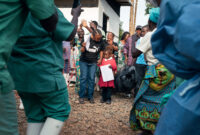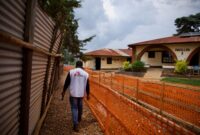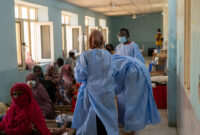
Mamouch and his mother Nyareu in the pediatric ward at the Malakal teaching hospital. He is receiving treatment for burns after he fell into a fire during a convulsive seizure. South Sudan, 2026. © Joanne Lillie/MSF
SHARE THIS:

South Sudan: When the river is the only road to healthcare

Using boats to provide healthcare to river communities in Upper Nile and Jonglei.

When 13-year-old Mamouch suffered a convulsive seizure at home one night, he fell into his family’s cooking fire in their village in Lankien, Jonglei State. Since the Doctors Without Borders/Médecins Sans Frontières (MSF) hospital in Lankien was bombed and destroyed in February 2026, his family had to travel more than 50 kilometres to the nearest functioning healthcare facility supported by MSF in Chuil. Given the severity of Mamouch’s burns, he was referred by boat to Malakal teaching hospital for specialized treatment. The family had been displaced twice by violence and eventually moved to Chuil.

“Life is very tough for us,” says Mamouch’s mother, Nyareu. “Some people in our community are dying from hunger, attacks by wild animals, by violence and our children are being kidnapped. Those who arrived in Chuil are lucky to be alive.”

Nyareu and Mamouch travelled for seven hours in an MSF boat to reach Malakal teaching hospital — the only possible mode of transport in an area where roads are inaccessible, particularly during the rainy season.

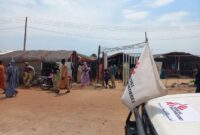
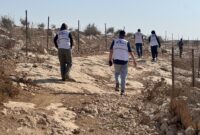
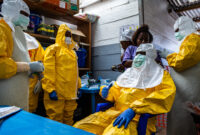
An outreach team arrives in Kodok to provide healthcare to remote communities who live along the White Nile River in Upper Nile State. South Sudan, 2026. © Joanne Lillie/MSF

Reaching remote communities

MSF outreach teams and boats are essential ways for communities living along the rivers in Upper Nile and Jonglei states to access healthcare.

“We have been receiving many patients from different locations along the South Canal, Akoka and Baliet routes within the Sobat River Corridor, due to gaps in primary healthcare, particularly referral pathways,” says Prisca Okoro Orji, community engagement and health promotion manager.

In Jonglei and Upper Nile states, MSF runs a decentralized model of care, supporting primary healthcare centres to provide basic care while helping refer patients who need specialized treatment to Malakal.

MSF currently has 18 community outreach team members at six sites, covering a combined population of around 50,000 people. Three more teams are being trained in August 2026 to provide care in Fashoda County.

“In some cases, we see the number of consultations is 10 times the population of a town, this shows us people are coming from much further away to access care.”

Alim Halidou, MSF nursing activity manager for outreach in Malakal

Each team consists of three community health workers chosen by the community and trained by MSF: a traditional birth attendant and two healthcare workers. “The primary healthcare units do not always have capacity or medications — that’s why we are expanding our support in the region,” says Prisca.

The decentralized model is essential to provide access to healthcare to every person who needs it in a wide and difficult-to-reach geographic area.

“In some cases, we see the number of consultations is 10 times the population of a town, this shows us people are coming from much further away to access care, medication and therapeutic food because the primary healthcare unit has nothing,” says Alim Halidou, MSF’s nursing activity manager for outreach in Malakal.

When someone needs specialist care, MSF refers them to Malakal teaching hospital, where MSF teams together with the Ministry of Health, provide neonatal, pediatric, nutrition, emergency, chronic care and surgical services including cesarean section.

Mamouch and his mother Nyareu in the pediatric ward at the Malakal teaching hospital. He is receiving treatment for burns after he fell into a fire during a convulsive seizure. South Sudan, 2026. © Joanne Lillie/MSF

Surgical care is needed across the region

Malakal is now the only secondary hospital with surgical capacity across large parts of Upper Nile and Jonglei states.

In the male surgical ward, Dak* is recovering slowly from gunshot wounds.

When he and other people from the community started moving their families and their cattle from Lankien to Chuil in search of food, they were attacked by armed men in a forest. Ten people of Dak’s group were killed and six were shot and left to die in the forest. The attackers kidnapped many of the group’s children, including seven of his nieces and nephews.

When his family came looking for him days later. They carried him on foot for seven hours to the MSF-supported facility in Chuil. When Dak was stable, MSF transferred him by boat to Malakal teaching hospital for surgery. Surgeons were able to remove bullets from his chest, lower limbs and pelvis.

“I only have pain now in my upper body and around my heart,” Dak says. “I don’t feel my legs and I can’t move my toes.”

Dak will receive post-operative care as long as it’s needed, including mental health support.

Boats bringing people to care

Boats are needed to navigate the three river systems in the Upper Nile State. MSF has also provided canoes to each outreach site so people can get to primary care locations. The outreach is having a positive impact with teams now seeing reduced mortality and an increase in health knowledge.

“It is really important we have decentralized care activities, because otherwise there is no treatment available for most of these patients,” says Joana Pires Borges, MSF pediatrician working in Malakal. “We are continuing to engage communities in these activities so we can build trust with families and so that relatives will bring their loved ones to outreach locations when they need healthcare.”

Nyawarka, a three-month-old baby was transported on the MSF boat after she was bitten by a snake while sleeping in the family’s tukul [traditional thatched hut] one night in their village along the White Nile River.

Nyawarka’s crying woke the neighbours, who came to help. First, they tried traditional medicine, but the next morning when she was no better, they contacted the MSF outreach team who sent a boat to pick up the little patient.

“I am very happy the boat came,” says Nyawarka’s mother Nyanyuem.

While outreach activities and boat referrals are proving a lifeline for families along the rivers in Upper Nile and Jonglei states, MSF teams cannot reach everyone. Primary healthcare services must be made functional and properly supported across Jonglei, Upper Nile and the rest of South Sudan. This requires sending enough healthcare workers, ensuring regular supplies of essential medicines, therapeutic food, vaccines and medical equipment and maintaining referral pathways so patients can move safely from primary care to specialized treatment when needed.

As violence, displacement and hunger continue to increase medical needs, access to secondary healthcare and surgical services must also be expanded, so people can receive essential care closer to where they live and in time.

*Name has been changed to protect identity