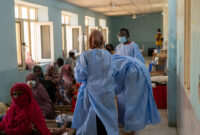
At the MSF inpatient therapeutic feeding centre in Kandahar, eight-month-old Nomania is being treated for malnutrition and tuberculosis, as she rests on a bed with her mother. Afghanistan, 2026. © Nazia Kamal/MSF
SHARE THIS:

Afghanistan: When malnutrition compounds childhood tuberculosis

Early detection gaps and stigma delay care for children.

“She has been sick for the last three months, with a persistent fever and cough,” says Nooria. Her eight-month-old daughter Nomania was admitted to the Doctors Without Borders/Médecins Sans Frontières (MSF) inpatient therapeutic feeding centre in Kandahar, southern Afghanistan and later diagnosed with tuberculosis (TB).

“I went to a medical store and bought injections for her,” says Nooria. “She improved for five days but then became as sick as before. When the driver guided me to this place, I was weeping. They did an X-ray and said she has TB.”

Malnutrition is a major risk for TB infection and progression to active TB, especially among children. Active TB exacerbates malnutrition by causing weight loss and increasing the body’s energy demands to respond to the infection.

“In malnourished children, even a small bacterial load can worsen their condition – but this small bacterial load often results in negative laboratory tests. This makes diagnosing TB in malnourished children more difficult than in adults.”

Ziaurahman Stanikzai, MSF medical doctor supervisor for nutrition in Kandahar

Afghanistan grapples with a high burden of TB as well as child malnutrition. Yet, detecting and diagnosing pediatric TB in malnourished children remains challenging and the level of awareness of these compounding diseases among communities is quite limited and stigmatized, which often results in delays in seeking the needed care.

An MSF nurse prepares daily doses of tuberculosis (TB) medications to support treatment adherence, especially for patients with limited education. Afghanistan, 2026. © Nazia Kamal/MSF

“The symptoms of TB that are common in adults, such as cough and sputum production, are often absent in children,” says Ziaurahman Stanikzai, MSF medical doctor supervisor for nutrition in Kandahar. “A child may have TB but shows signs like poor weight gain, vomiting, diarrhea or lack of response to nutritious food. In malnourished children, even a small bacterial load can worsen their condition – but this small bacterial load often results in negative laboratory tests. This makes diagnosing TB in malnourished children more difficult than in adults.”

In 2025, at least 10 per cent of malnourished children treated by MSF team in Kandahar were diagnosed with TB – more than double the 2024 figure. Rather than signalling a worsening health burden, this increase highlights the importance of the team’s systematic TB screening during admission into the nutrition program. It is widely believed that TB in malnourished children is underestimated and underdiagnosed.

MSF’s response to tuberculosis and malnutrition in Kandahar

To address this, MSF teams in Kandahar have adopted a multi-pronged approach that includes systematic screening and a robust referral pathway for specialized TB care. When patients arrive at our facilities for the nutrition program, the team conducts medical screening, covering medical history, household contact tracing and clinical assessment. Based on the results, an X-ray may be performed for confirmation. Patients then receive nutritional support and start TB treatment during admission. Once malnutrition treatment is complete, patients are referred to the provincial TB centre for ongoing advanced TB care.

Since 2016, MSF has been providing care for drug-resistant TB (DR-TB) patients in Kandahar province. MSF runs a dedicated DR-TB hospital with a laboratory, an outpatient clinic and a 24-bed inpatient department. This facility serves as the main referral centre for DR-TB cases across Kandahar and southern Afghanistan.

At the same time, MSF operates a 45-bed inpatient therapeutic feeding centre and an outpatient therapeutic feeding centre to respond to malnutrition in children under five. This integrated setup enables proactive screening and treatment of malnourished children with TB. Additionally, the team is supporting the National TB Control Program through existing drug-sensitive TB structures in the provinces with screening, detection and referral linkage for DRTB treatment in provincial treatment centres in Kandahar.