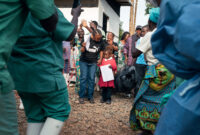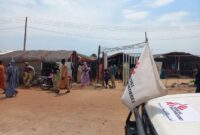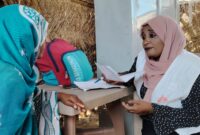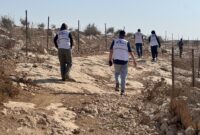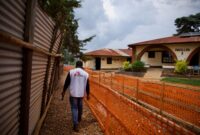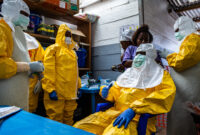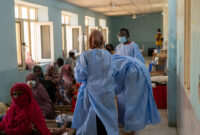
Two MSF staff workers inside the Ebola isolation centre, in Butembo. Democratic Republic of Congo, 2026. © Paul Lorgerie/MSF
SHARE THIS:

Democratic Republic of Congo: MSF opens a new Ebola Treatment Centre and strengthens its work with communities

In North Kivu, MSF strengthens community engagement in the response to the outbreak.

The Ebola disease outbreak continues to spread in eastern Democratic Republic of Congo (DRC). In North Kivu, Doctors Without Borders/Médecins Sans Frontières (MSF) is caring for people affected by the virus and is setting up an Ebola Treatment Centre in the city of Butembo. MSF is also supporting social groups and community leaders in Butembo and Beni to tailor patient care and make public awareness activities as effective as possible.

« In Butembo, people arrive at health facilities at an advanced stage of the disease, which explains the high case fatality rate, and even though the monitoring system is improving, nearly half of those who are sick have been in contact with cases that have not been identified. »

Hugo Soubrier, an epidemiologist with MSF’s emergency team in North Kivu

Isolation measures and the degradation of warning systems

In Butembo, MSF has renovated a building at the general referral hospital to set up a 35-bed Ebola Treatment Centre, which opened in early July. A single pane of glass separates Denise from her younger sister, who has been admitted to the isolation centre in Butembo. “It reassures me to see her,” Denise says. The test results have not yet come back to confirm whether Denise’s sister has Ebola disease caused by the Bundibugyo virus. Every day and every night, Denise and her family members watch and wait. While the test results may come back negative, some of her neighbours have tested positive for the virus.

“The idea behind this isolation measure is to stem the spread of the disease, but also to allow caregivers and family members to visit patients,” says Delmas Kalemba, MSF’s logistics manager.

As the Ebola disease outbreak spreads, early warning systems are breaking down. As of July 13, 2026, the health zones of Butembo and Beni had recorded 122 and 31 confirmed cases, respectively, with 77 and 20 deaths. “This is well below the actual numbers,” says Hugo Soubrier, an epidemiologist with MSF’s emergency team in North Kivu. “In Butembo, people arrive at health facilities at an advanced stage of the disease, which explains the high case fatality rate, and even though the monitoring system is improving, nearly half of those who are sick have been in contact with cases that have not been identified.”

The 17th Ebola outbreak in DRC is unfolding against a backdrop of tense security conditions, creating fertile ground for rumours. Armed groups are fuelling rampant insecurity in Butembo and Beni – the second and third largest cities in North Kivu province. Meanwhile, residents are still reeling from the last outbreak (2018–2020). The loss of a loved one, a lack of information, fear of the disease and infected people denied visitation rights – all these traumatic events have eroded the community’s trust in the people leading the “response”. In 2019, an Ebola Treatment Centre co-managed by the Ministry of Public Health and MSF was partially burned down, forcing the teams to suspend their activities in the city.

A hospital staff member washes personal protective equipment in the MSF-supported isolation centre in Butembo . Democratic Republic of Congo, 2026. © Paul Lorgerie/MSF

A disease shrouded in rumours

“Some people advised us not to go to the health centre,” says Elise*, whose husband tested positive for the virus. “They told us the doctors were going to give us medicine that would make my husband sick with Ebola.” Elise prefers to stay near her husband rather than risk infecting her children or facing stigma in the community. MSF has provided her with a caregiver room within the hospital.

In regions where humanitarian assistance is scarce, the return of those involved in the previous outbreak is fuelling certain misconceptions. “Similar rumours come from all segments of the community,” says Pablo Paluku Lwanzo, chief medical officer of the Butembo health zone. “Some say Ebola doesn’t exist, or that we’re poisoning people.” This misinformation is compounded by another notion that emerged during previous outbreaks: the “Ebola business.” According to investigations published in the press, the response during the last outbreak was marked by abuse, including gender-based violence and embezzlement. The breakdown in trust has consequences: people are less likely to seek treatment and humanitarian staff are put at risk.

Members of the medical team at the Butembo isolation centre are setting up a ventilator in a room to assist a person with Ebola diseaseexperiencing respiratory distress. Democratic Republic of Congo, 2026. © Paul Lorgerie/MSF
A woman sits outside her younger sister’s room waiting for test results to confirm whether her sister has Ebola disease caused by the Bundibugyo virus. Democratic Republic of Congo, 2026. © Paul Lorgerie/MSF

Communities at the heart of the response

On July 10, it was reported that the outbreak had spread to Tshopo and Haut-Uélé provinces. To restore trust between residents and healthcare workers, and to contain the outbreak, MSF is encouraging residents to be at the heart of the response.

“They are the ones who have already lived through Ebola,” says Margot Grelet, project coordinator in Butembo. “They have the on-the-ground knowledge, understand the challenges and know what response is most appropriate. MSF’s added value here is our ability to secure medicines and equipment and to provide trained medical staff.”

“We rely on group leaders, community leaders and civil society organizations to convey our messages within the communities.”

Delphine Ferry, health promotion coordinator

The teams regularly meet with various community and religious leaders to tailor their activities to be as effective as possible.

This community-centred approach is also being utilized by MSF in Béni, 50 kilometres north of Butembo. “We rely on group leaders, community leaders, and civil society organizations to convey our messages within the communities,” says Delphine Ferry, health promotion coordinator.

Currently most people arrive at the Butembo Ebola Treatment Centre with advanced symptoms. However, to improve care and the rates of survival, the goal is to encourage people not to wait and to come to a health centre as soon as symptoms appear.

The 150 community liaison staff trained by MSF need to answer a variety of questions. What is the Bundibugyo virus? How are people cared for in treatment centres? What support does MSF provide to families? Hailing from the neighbourhoods themselves, the community liaison teams share important health information from MSF and the Ministry of Public Health. They are supported by MSF health promotion teams working in the various health zones.

MSF’s commitment to working closely with communities is also reflected in our operational decisions. In addition to building a 26-bed treatment centre for Ebola patients near the general referral hospital in Beni, MSF is also decentralizing our response, providing free primary healthcare at two health centres. Twelve observation rooms have been built in the health facilities of the Kanzulinzuli and Malepe health zones and eleven more are under construction in the Madrandele and Kasabinyole zones. These facilities allow people suspected of having the Ebola virus to receive care, food and visits from loved ones while they wait for their test results, all while protecting their families.

*Names have been changed to protect identity