Palestine: MSF resumes core lifesaving activities at Nasser hospital
MSF’s head of emergency operations Michel Lacharité discusses MSF’s decision to return to Nasser hospital
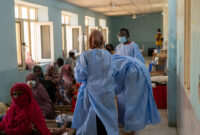
MSF has made the decision to resume our core activities at Nasser hospital as of April 13, after we suspended our non-critical activities as of Jan. 20, 2026. Michel Lacharité, Doctors Without Borders/Médecins Sans Frontières (MSF) head of emergency operations, provides details on our resumption of core activities in an interview.
Why is MSF resuming core activities at Nasser hospital?
We have decided to resume our core activities at Nasser hospital after continuously engaging with Gaza’s Ministry of Health and assessing the situation. We have determined the concrete actions taken by the relevant authorities have allowed the minimum conditions required for our teams to work safely and in line with our working principles.
Since the suspension of our non-critical activities (outpatient, physiotherapy, 3D-burns and mental health) in Nasser, our teams have seen clear and marked improvements in the situation.
We had originally made the difficult decision to suspend all non-critical medical activities on Jan. 20, 2026, after MSF staff witnessed a series of incidents. These included the presence of masked armed men and others engaging in intimidation and carrying out arbitrary arrests of patients. There was also one incident involving the suspected movement of weapons. All of these incidents are completely unacceptable and we raised these concerns to the relevant authorities.
We have now resumed activities. This decision reflects both the gravity of needs and concrete improvements in how the facility is being managed, including measures to restrict the entry of weapons and armed individuals.
We work in a context in Gaza where functioning medical facilities are extremely scarce, where needs are acute and concentrated and where patients and staff arrive in conditions of extreme distress. In this environment, some degree of crowd management and access regulation is unavoidable – not to control who receives care, but to maintain the conditions under which care can be provided safely and without discrimination.
We acknowledge police and security personnel may be present in and around the facility, as may occur in other contexts. This does not reflect an endorsement of armed presence within medical spaces, nor does it alter our commitment to the principle that the hospital must remain a protected space, neutral and accessible to all. As such, we will continue to monitor conditions.
What activities has MSF resumed?
MSF maintained critical activities in Nasser hospital throughout this period, including the inpatient and surgical departments for patients with orthopedic, traumatic or burn injuries — in these departments patients’ lives depended entirely on MSF care. Having now received assurances, we have resumed outpatient consultations, physiotherapy, occupational therapy, 3D-burn screening and mental health activities.
MSF now supports 94 beds in the surgical inpatient department, including 23 beds for burn patients.
How can you ensure the hospital stays a neutral space free of military activity?
MSF does not run the hospital and is not present in all wards. However, we continuously monitor and assess existing risks and engage with the Ministry of Health to ensure conditions remain compatible with the delivery of impartial medical care. As well, we check that the security of staff and patients is safeguarded, as we do in all countries we work in. Our presence is contingent on the hospital functioning as a civilian medical facility. The Ministry of Health has committed to maintaining conditions that allow us to continue treating patients safely.
Nasser is a critical lifeline for people in Gaza and one of the last remaining partially functioning Ministry of Health hospitals in Gaza. It must be respected and protected as a civilian medical facility, in accordance with international humanitarian law.
Our calls shouldn’t be instrumentalized. We have seen Israel obliterating the health system in Gaza with the justification they are being used as command centres or for military purposes, which we never witnessed. Nasser must be spared from Israeli attacks and it must not be used for any military purposes by Hamas or any other armed groups. The lives of countless Palestinians depend on it.
Related news
Middle East and North Africa: Behind the armour, men’s mental health
Palestine: Ceasefire in Gaza, humanitarian aid must flow immediately