Hope is stronger than hate
Canadians often ask us what difference hope can make in a world that feels increasingly fractured. Through the Hope Is Radical campaign, we’re sharing the testimonies of health workers who refuse to surrender to hate. Their daily work is the answer.
In Mexico, hope is carried by people like Dr. Mercedes Alarcón, a physician with Doctors Without Borders/Médecins Sans Frontières (MSF). She works alongside the team at the Comprehensive Care Centre (known as the CAI in Spanish) in Mexico City, where MSF provides care to survivors of extreme violence and torture, including medical care, psychology sessions and physical therapy.
It’s still dark as I ride my bike to work at the CAI. The sun rises as I cycle through the waking city, passing underneath the canopy of blooming jacaranda trees that line the streets. The perfume from their lavender-coloured flowers is thick in the air. It’s spring.
Despite the idyllic morning scene, I brace myself for the day ahead. Soon I will hear horrific stories of extreme violence and torture in the CAI’s counselling room. Survivors have lived through cruelty I never could have imagined: extortion, murder, sexual violence, human trafficking. Some tell me about being forced to watch criminal gangs torture their family members.
The weight of these stories feels particularly suffocating lately. I picture a giant backpack strapped onto me as I cycle, packed to the brim with patient’s testimonies. My shoulders sag under the load. It’s easy to feel heavy and overwhelmed when you hear detailed accounts about the abject hate and violence that force people to seek care at the CAI. Still, I pedal forward.
Reaching the centre, I push open the front gate; all is quiet. Across the courtyard, a mural is splashed across one wall,designed by patients and a local artistt. It’s full of imagery from the different regions our patients have come from: flowers for Mexico, mountains for South America, a sun for Africa. Regardless of their countries of origin, people have fled abuse and violence, only to be met with more of the same along the dangerous migration routes and again here in Mexico City.

The sun is bright overhead, the play area bustling with children and their families. A group of adults gather, talking softly. Friendships form here, people bonded by similar experiences. Learning to connect with others again is part of healing.
Upstairs, patients are emersed in an art therapy session. Some trauma can feel too heavy to voice out loud, so we lead people to draw or write. A young boy draws a house, a dish he misses desperately from back home.
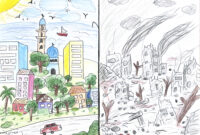
I pick up my own paint brush to process my feelings as I bear witness to the extreme suffering around me. The world comes to me in colours and textures. Sadness is deep purple, while hope shows up as lavender, the colour of the jacaranda flowers I see on my way to work.
Back in the counselling room, I speak with a young girl who has stopped eating. Her family is worried. I listen to her chest with my stethoscope, and she tells me her heart sounds sad. My own heart breaks.
A woman we discharged a few weeks ago returns to the CAI. She has been sexually assaulted again. Last time she was a patient here, she drew beautiful mandalas for the team. This time, there are no mandalas. Her physical health starts to fail, and she is admitted to the hospital. It feels like violence will never end.
Deep purple swirls around me, threatening to pull me under. I am cold, exhausted. The world feels like it’s breaking from the inside out. Headline after headline reports wars, mass displacement, deportations. More violence. More hatred. I can see how people may feel helpless in the face of so much pain and indifference. Sometimes I feel that way, too. There are days when I think how much easier it would be to turn away, to never return to a place where the most insidious parts of humanity are laid bare through my patients’ stories and injuries.
But I refuse to stop caring. I know in this moment of global upheaval, the care and compassion I carry with me is anything but soft or gentle.
In a world that increasingly rewards indifference or neglect, my care is my act of defiance. In a time when some of the most powerful voices have megaphones to spew hate and division, my empathy is my resistance.
My colleagues help carry me through deep purple days like this one. We remind each other that while we can’t take away people’s emotional pain, we can accompany them through their suffering and create a safe place to land. Through small daily actions, we see how our collective hope can be a more powerful force than hate.
As the weeks pass, I see something start to shift in the woman we have re-admitted to the CAI. Her health improves. She hands me a vibrant mandala she painted during an art therapy session. My heart soars.
And then again, another sign of hope: a woman who has survived devastating violence finally speaks to me in a counselling session. Her face softens with a mirada, a sign of someone feeling completely safe. “I can finally breathe again,” she tells me. “I can leave this story here.”
Suddenly, my phone pings; it’s an email from the family of the young girl who had trouble eating. I can still hear her voice begging for a lollipop at the end of every session. They’ve included a photo of the whole family smiling in the snow. They’re safe now. And the girl is clutching a lollipop.
Evening comes, and the load I’ve been carrying lightens as I cycle home underneath the jacaranda trees. Their lavender colour dances around me, and I am filled with a quiet certainty that hope is stronger than hate. Here, below the jacaranda trees, hope is radical.