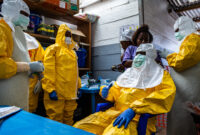
An MSF nurse checks a child with a stethoscope as his mother gently calms him at the new malaria ward in Aweil State hospital. South Sudan, 2024. © Isaac Buay
SHARE THIS:

The dire situation of South Sudanese people and how urgent action is needed to prevent a crisis

Conflict, climate change and shrinking humanitarian support are overwhelming South Sudan’s fragile health system.

Mamman Mustapha
Country director

Amid humanitarian aid cuts, a convergence of conflict, malnutrition and climate events ranging from droughts to floods have plunged South Sudan into the worst conditions people have seen since 2018.

When South Sudan emerged as the world’s newest nation in 2011, hope soared for a fresh start. But just two years later, the country plunged into a brutal civil war. A 2018 peace deal offered a fragile chance at recovery, but last year that hope was shattered.

What is needed now is a shift in response and renewed commitment from donors, not turning away. The scale of suffering is growing and no single organization can fill the gaps alone.

The year 2025 saw a severe escalation in violence. More than 300,000 people have been uprooted from their homes and at least 2,000 have been killed, as fighting spreads from one state to the next. In the first half of 2025, Doctors Without Borders/Médecins Sans Frontières (MSF) treated over 740 people for violence-related injuries in Jonglei and Upper Nile, including gunshot wounds and burns.

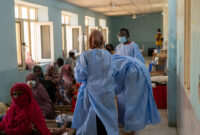
A nurse reassures a patient ahead of a caesarean section in Mundari county hospital, the only secondary health care facility in Kajo Keji, Central Equatoria. South Sudan, 2024. © Manon Massiat/MSF

Funding decreases as conflict drive up needs

The surge in conflict is unfolding precisely as international assistance, particularly support for health services, falls to its lowest level since independence. Across the areas where MSF works, health facilities are barely functioning or have shut down entirely. The Health Sector Transformation Project — the multi-agency initiative launched in July 2024 to support 1,158 facilities — is faltering, with roughly 30 per cent of the targeted facilities receiving no support at all. Many of those that do remain crippled by stock-outs and understaffing. Compounding this, the government allocates less than two per cent of its national budget to health, far below its 15 per cent commitment.

The result is a perfect storm. Armed clashes now converge with flooding, acute malnutrition, disease outbreaks and the near collapse of basic services. Millions of South Sudanese are being pushed into a catastrophe at a scale not seen since 2018.

It is not only a lack of resources or a poorly functional assistance system that has led to the closure of facilities. Violence has involved direct and indiscriminate attacks on civilians and health facilities, in violation of international humanitarian law. MSF suffered nine attacks on our hospitals or staff last year, resulting in the forced closure of two hospitals in Greater Upper Nile, as well as the suspension of essential primary care activities in Jonglei, Upper Nile and Central Equatoria. None of this can become the “new normal.”

The current health system is already unable to cope with the overwhelming needs and an unacceptably high number of people, largely women and children, dying from treatable and preventable diseases.

In many conflict-affected and hard-to-reach areas, medical humanitarian agencies like MSF are the only ones providing lifesaving services. When facilities are destroyed, communities are left with nowhere to turn. The closure of two hospitals and suspension of services left more than 400,000 people without access to essential healthcare. When an MSF hospital in Ulang was attacked and looted, more than 100 patients — including pregnant women, children and survivors of violence — were receiving critical treatment at the time.

One MSF colleague describes fleeing Ulang and temporarily sheltering in a health centre in Nasir county. He witnessed a mother arrive in labour, but her baby died. When the mother developed a postpartum infection, staff struggled to deliver care due to a lack of essential equipment and drugs, including antibiotics. Displaced again by aerial bombardments, the MSF team took the mother to the Ethiopian border — the closest place she could receive treatment.

The current health system is already unable to cope with the overwhelming needs and an unacceptably high number of people, largely women and children, dying from treatable and preventable diseases. People arrive at facilities to find there are no drugs. On top of that, since the beginning of the war in neighbouring Sudan, more than one million returnees and refugees have entered South Sudan seeking safety. This adds further strain to an already fragile medical and humanitarian system.

The MSF health promotion team conducts an informative session with community leaders at an internally displaced persons camp in Malakal, empowering them to help safeguard their communities against outbreaks of disease. South Sudan, 2024. © Paula Casado Aguirregabiria

Donor fatigue cannot define 2026

Support from international governments and agencies to the South Sudanese health system has dwindled in recent years. Major UK Aid Direct cuts in 2022 left around 200 facilities — including eight major hospitals — unsupported. In early 2025, the United States, which funded 55 per cent of South Sudan’s humanitarian appeal, announced a suspension and subsequent termination of many humanitarian contracts.

The children, families and communities of South Sudan deserve more than plans and promises — the world must deliver. For this to happen, humanitarian access, protection of civilians and respect for health facilities must be guaranteed.

What is needed now is a shift in response and renewed commitment from institutional donors, not turning away. The scale of suffering is growing and no single organization can fill the gaps alone. The international community must renew its commitment: funding cannot falter, and donor fatigue cannot define 2026.

At the same time, the country’s health system needs urgent, tangible support. Programs like the Health Sector Transformation Project are vital lifelines, but they cannot function on paper alone. Medicines must reach the people who need them, facilities must be staffed and equipped and care must extend beyond the basics to meet critical needs.

The children, families and communities of South Sudan deserve more than plans and promises — the world must deliver. For this to happen, humanitarian access, protection of civilians and respect for health facilities must be guaranteed. The government of South Sudan must also scale up its national budget allocations for health, in line with its Abuja Declaration commitment of allocating 15 per cent to health. Without action, another crisis — worsening day by day — is taking shape in East Africa, a region already burdened by multiple emergencies.


Mamman Mustapha joined MSF as a nurse in 2007, working in nutrition and measles programs in northern Nigeria. He has since worked across several countries, including Nigeria, South Sudan, Yemen, Uganda, Afghanistan and Libya.