Sudan: Three years of war have shattered Sudan’s lifelines
Warring parties are dismantling country’s capacity to protect, heal, sustain its own people.
Three years of devastating war in Sudan have dismantled the essential services people rely on – including healthcare, protection, food security and basic safety.
Beyond causing direct casualties, the conflict between the Sudanese Armed Forces (SAF) and the Rapid Support Forces (RSF), along with the allied groups of both parties, is inflicting profound and far‑reaching harm. This is driving severe health consequences for people in Sudan.
In 2025, teams with Doctors Without Borders/Médecins Sans Frontières (MSF) treated more than 7,700 patients due to physical violence, provided more than 250,000 emergency consultations and carried out over 4,200 consultations for sexual violence. Sexual violence has been widespread and used as a weapon of war, with women bearing the heaviest burden.
Over the same period, more than 15,000 children under five were admitted to our inpatient feeding programs for acute malnutrition. Malnutrition is on the rise, compounding the risk of death from an otherwise treatable illnesses.

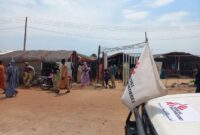
Tawila, North Darfur.
The health impacts of conflict
Throughout the conflict, vaccination programs have been disrupted and disease surveillance systems have collapsed. This has accelerated the spread of diseases and delayed epidemic detection. The international humanitarian response — including that of UN agencies, particularly in Darfur — remains far from sufficient to prevent avoidable loss of life.
Funding cuts are making an already dire situation even worse, with people once again paying the price. People are dying from preventable causes because Sudanese authorities and the world are failing to come to their support.
“My baby girl was born prematurely because the war forced us to flee from Omdurman while I was pregnant. … Because of the war, she couldn’t get vaccinated.”
Ferdos Salih, mother of a measles patient at El Geneina teaching hospital
MSF has witnessed recurrent outbreaks of deadly, yet preventable, diseases across Sudan — from measles in Darfur to hepatitis E in Al Jazirah state and cholera in Khartoum and White Nile. These surges are claiming the lives of the most at risk, especially children and pregnant women. In 2025, we treated more than 12,000 patients for measles and nearly 42,200 for cholera.
“My baby girl was born prematurely because the war forced us to flee from Omdurman while I was pregnant,” says Ferdos Salih, mother of an 11-month-old baby with measles and severe acute malnutrition in El Geneina teaching hospital in West Darfur. “She has suffered a lot, with repeated hospitalization. Also, because of the war, she couldn’t get vaccinated.”
In addition to that, hospitals have been looted, bombed and occupied. Medical staff have been threatened, detained or forced to flee. Ambulances have been blocked from reaching the wounded.
Attacks on healthcare further weaken Sudan’s system
Since April 2023, more than 2,000 people have been killed and 720 injured in 213 attacks to health facilities across the country. In 2025, Sudan accounting for 82 per cent of all global deaths from attacks on healthcare, according to the World Health Organization. During that same period, MSF documented 100 violent incidents targeting our staff, the facilities we support and medical supplies.
As recently as April 2, an attack on Al Jabalain hospital, reportedly carried out by the RSF, resulted in 10 fatalities. Among the people killed were seven medical staff, some of whom had previously worked with MSF. Only two weeks prior, on March 20, an attack reportedly carried out by the SAF on El Daein hospital in East Darfur resulted in the deaths of 70 people, including 15 children.
“Three years of war have already cost Sudan immeasurably. Allowing this trajectory to continue risks condemning an entire generation.”
Amande Bazerolle, MSF country director
Yet, despite constant threats, repeated attacks from both warring parties and ongoing international indifference, Sudanese volunteers and medical staff continue to show extraordinary dedication, striving to provide care where it’s most needed.
“Sudanese authorities continue to make it sometimes impossible for MSF and other humanitarian agencies to deliver or scale up lifesaving care — whether by blocking our entry into certain areas or by preventing us from carrying out activities even after we have arrived,” says Amande Bazerolle, MSF country director in Sudan. “Being prevented from intervening forces MSF into an unacceptable position: unable to respond to avoidable suffering and death despite being ready and willing to do so.”
Today, the vast south-central region of Kordofan is the most volatile and active conflict zone. It is one of the least accessible areas for humanitarian organizations, leaving communities even more exposed as violence intensifies.

A pattern of unrelenting violence against civilians
In recent months, MSF has observed a disturbing shift in the conduct of the war, including an extensive use of drones by both the RSF and SAF. These strikes are increasingly occurring far beyond the front lines, targeting logistical infrastructure and populated civilian areas.
Since February, MSF has treated around 400 people for drone injuries after strikes hit civilian areas in eastern Chad, as well as in various areas of Darfur. According to the UN, these attacks have killed over 500 civilians from Jan. 1 to March 15.
“The teams are receiving patients with horrific injuries: patients with both entry and exit wounds, amputated limbs, devastating burns – many of whom are already dead by the time they reach the hospital,” says Muriel Boursier, MSF emergency coordinator in Darfur. “The scale of violence and atrocity we witness is unbearable.”
These strikes, carried out in blatant disregard for international humanitarian law, are not consistently directed at military targets. This marks yet another severe deterioration in a conflict where people’s suffering continues to deepen.

Sudan, 2026. © Cindy Gonzalez/MSF
It’s not too late to help Sudan
The crisis in Sudan is not only a humanitarian catastrophe — it is also a collective political failure. After three years of what has become the world’s largest humanitarian crisis, the response from governments and international organizations has failed to meet even the most basic expectations.
Repeated warnings of atrocities, including those committed against non-Arab communities in El Fasher by the RSF, have led to no meaningful action.
Meanwhile, children, mothers and others in communities continue to die every day – whether from indiscriminate violence against civilians, including mass killings, starvation, torture and rape, or from a lack of basic services that the international humanitarian system is supposed to deliver.
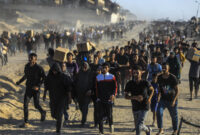
Since April 2023, nearly 14 million people have been forced from their homes and many had to flee multiple times, losing everything. The two warring parties, who previously formed Sudan’s government, are dismantling the country’s capacity to protect, heal and sustain its own people.
Sudan and Chad: Surviving tomorrow, the communities displaced by conflict
Award-winning photographer Moises Saman documented the experiences of people displaced by conflict in Sudan.
“Now more than ever, protection of civilians, respect for healthcare facilities, accountability for atrocities and sustained humanitarian access are urgent and non-negotiable,” says Bazerolle. “Three years of war have already cost Sudan immeasurably. Allowing this trajectory to continue risks condemning an entire generation.”
Warring parties and their allies must take immediate, concrete steps to protect civilians. They must be held accountable for the ongoing violations that are inflicting immense suffering on Sudanese communities.
Influential international agencies must urgently exert meaningful diplomatic pressure on those financing, arming or politically supporting the parties to the conflict. Even though they have so far tragically failed to use their leverage to stop mass atrocities, a window still exists to influence the situation and prevent further crimes.
Silence and inaction are prolonging the suffering of millions of people in Sudan.
Related news
Sudan: No safe place for women and girls in Darfur, MSF report finds